Weaving Waters Residency, Bribie Island, Queensland Australia, December 2025
1st December 2025
On arrival an overstimulation of the senses- cranes, ibis, kookaburra, pelicans, parrots, cockateels and galah, kangaroos, wallabies, huntsman spiders and bearded dragons. Also flora that is mostly unfamiliar to me but a sweet scent rides on the air, that reminds me of jasmine.

Opening Ceremony Kim, Aunty Leesha, Uncle Phil, traditional custodians of the land of Yirin (Yarun/ Bribie Island) from the Joondiburri Tribe. Welcome to country by Aunty Leesha.- “The land will speak if you listen.” Asking the sky and the land for permission. Welcome dance from community.
For custodian Kim Alison Tilly- “What’s important is being humble and being no better than anyone else.”
“Connection to country is good for you, there is a healing in nature and a disconnection from Earth makes us sick”

Language of Yirin is Ondu. Makhura- last of the descendents of Yirin/ Bribie salt water people
Bribie Island below
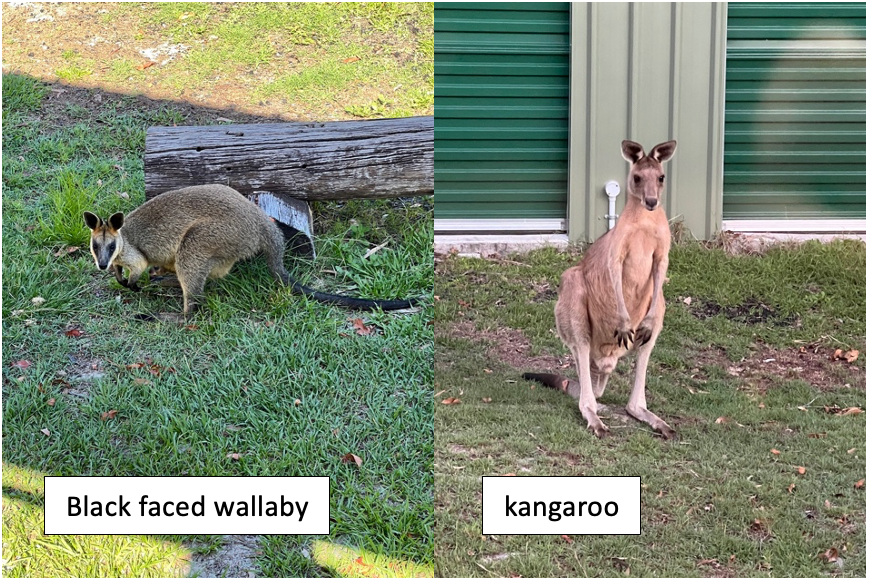
Another welcome committee
I had no idea nor anticipation of what this residency was going to be. I was imagining as it is on an island it had a water or island theme around place or the environment. I also had not anticpated what ‘weaving’ might be in this context and thought this was most likely metaphorical- as in ‘weaving a narrative’ around water or at the very least have some textile or tapestry related context.


My resources were limited so a trip to the ‘op’ (charity) shop provided me with fabric options of recycled pillow cases for drawing frottage with charcoal from the fire pit. Shells gathered from the beach in Redcliffe, south of Bribie Island where I stopped over to visit a friend before the start of the residency as well as branches and leaves from the land where we stood, were utilized as subject to guide me into place.

In another case of grounding I painted the same eucalyptus leaves and utilized gum nuts as tools. The gum nuts from the eucalyptus were already showing me what they could do (see the coloured circles above on the right hand side on top of the frottage and in below images, down the side of the pages). These sketches were just moments in grounding, trying to locate myself in place.

A guided visit to the Bribie National park alongside talks from animal trainers, biologists and environmentals… (open day Kylie at eco??) deepened local knowledge as well as the continuous circle of weaving that integrated us with local custodians and Indigenous artists.

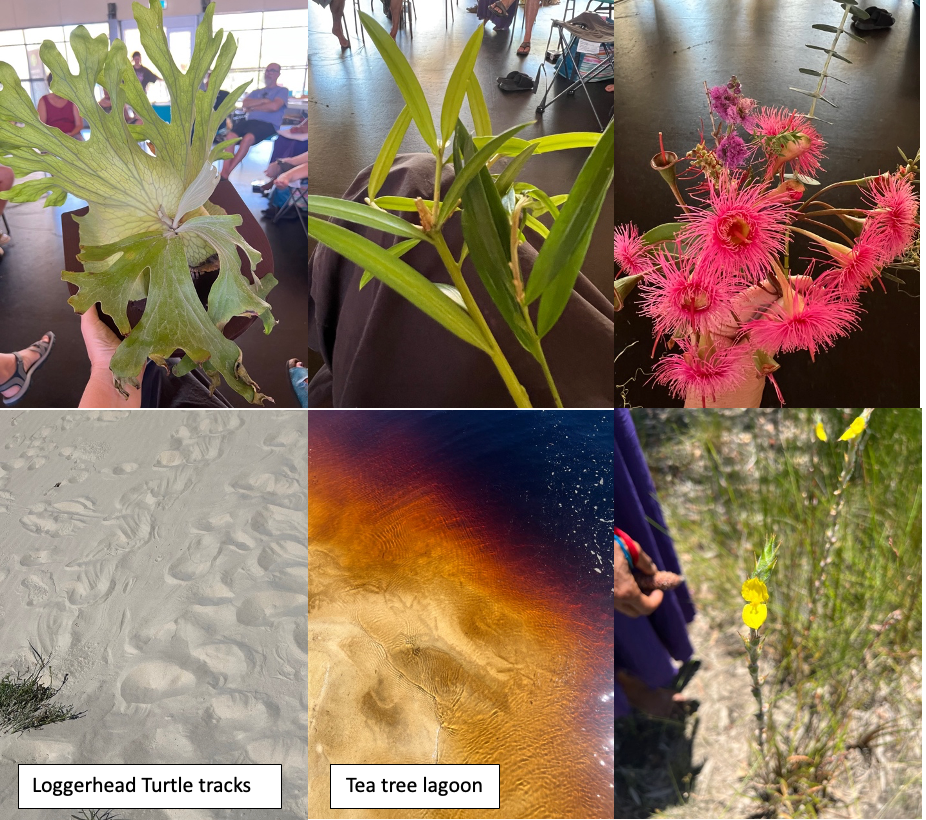
Tamsin Kerr’s workshop- Poetics of Place
As way of an introduction a poem by Mary Oliver, Praying
It doesn’t have to be
The blue irirs, it could be
Weeds in a vacant lot, or a few
Small stones; just
Pay attention, then patch
A few words together and don’t try to make them elaborate, this isn’t
A contest but the doorway
Into thanks, and a silence in which another voice may speak.
Take one hour in nature-
“Take your shoes off and put your feet on the earth; feel the fungal pulse of the place. Let the intimidating page know who’s boss; smear a little earth over its whiteness. Enter into conversation with minutaie around you; listen to the non-human voices. Remember the spaces in between, the dark matter and negative space that connects us all. Do your edits by reading aloud what you have written in place; listen for rhythm, remove discordance.”
As I walked through the land the gum nuts and leaves asked me to work with them. I heard their voices as I walked by them, initially ignoring them, but I hesitated and returned to pick them up. At first I worked with the watercolour paints I had brought along, with which I had earlier painted the eucalyptus leaves but this time dipping the plants in the paint and dragging them along the paper. In green it felt like tall grasses blowing in the wind; the words of fluidity, gentleness, flow, ease and flexibility reverberate. In orange the dragged leaves became flames, the words tongues of fire, complexity, layering and blanketing sprang forth.

I felt drawn to mix some coffee rock and fungus collected on earlier outings to the Bribie National Park bush, beach and mangroves. I ground down the rock and added it to some fungus dye that had been brewing for a few days to achieve the ink below. At first I simply dragged the dried eucalyptus leaves across the paper, this time it resembled tall slender tree trunks, much like the eucalyptus herself. The text inserted was in reference to the sample of Tamsin’s work that she had shown earlier as well as to the work of Penone who I had recently being reflecting upon. The text reads:
Weaving muddy waters, boughs bend, boughs break. Life is lost to the earth and soil and to transformation. Histories told and retold, questions answered. Teachings of techniques of fluidity softness and ease, of moving this body with that body converging knowledges and ability with fingers and form finding my way through her way listening. Weaving through the undergrowth voices crisp and clear, calling, offering themselves, their bodies to the process. They offer to show me the way. They don’t mind the constant dipping and dragging the beating on the page that creates their own rhythm holding space in community, a community of trees and roots and seeds leaves and soil.

She continues to show me more. More dipping and dragging, expressions of being of both intensity and softness. I bring my hand, my eye, my body and feeling, layering with hers and attempt to draw my impression of her.
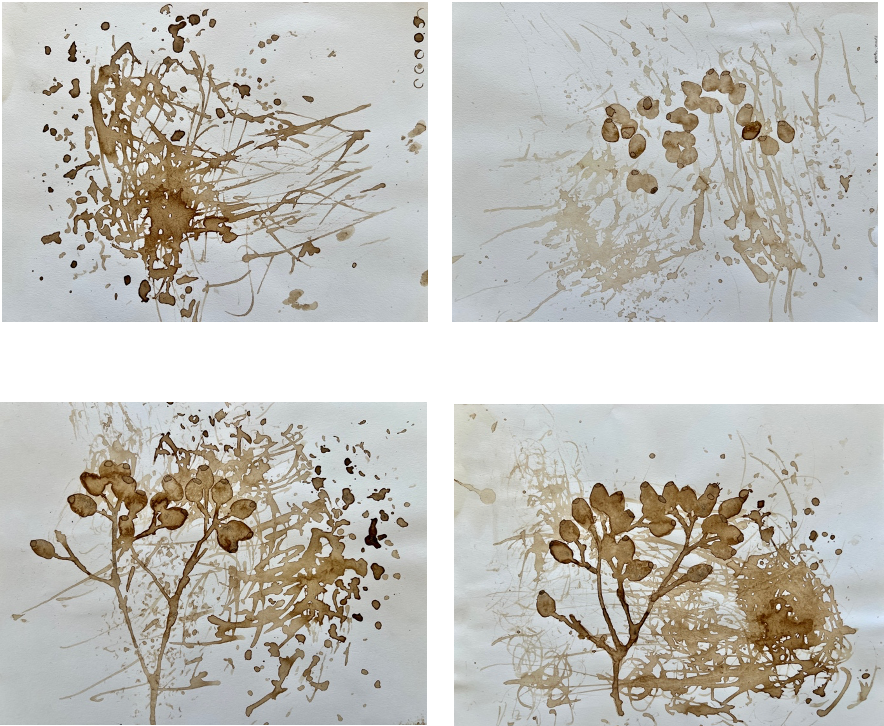
The gum nuts used as tool to create more dots more rhythm, her own code. Resembling the moon cycle.

Notes from workshop:
Pause, listen and pay attention
Make your paper dirty. Look from a birds eye perspective.
Nature writing. Sense of the more than human.
Stop talking, listen to other langauges, bird song, insects, sounds and dance
How to write well
Take your shoes off and feel your feet on the earth
Do your edits by reading aloud in space
Poetics of space always tell you about yourself past, present and future, never in linearity but cyclical.
Spiritual laws of mathematics- vedic laws
Holistic – all body and spirit- indigenous
Weaving with Yvonne

Weaving is more than just making baskets. It is about community. It’s about ‘yarning,’ and sharing stories, together. About listening, giving and receiving. Whilst others took time over their baskets, finely and neatly weaving them I wanted it to be more expressive, less controlled and rigid. I wanted the basket to have movement and to show me the character of the material rather than manipulating the materials to my way I hoped to weave it in relationship with kin, with the materials I was using, rather than dominate, overpower or over rule. I wouldn’t usually be moved to use colour, but the basket wanted to reflect my experience of Australia, of ocean, of land (of bush and of mangrove) and of sunshine.

Samples of weaving with other grasses, including Leanne Simpson weaving grasses from her own wetlands.

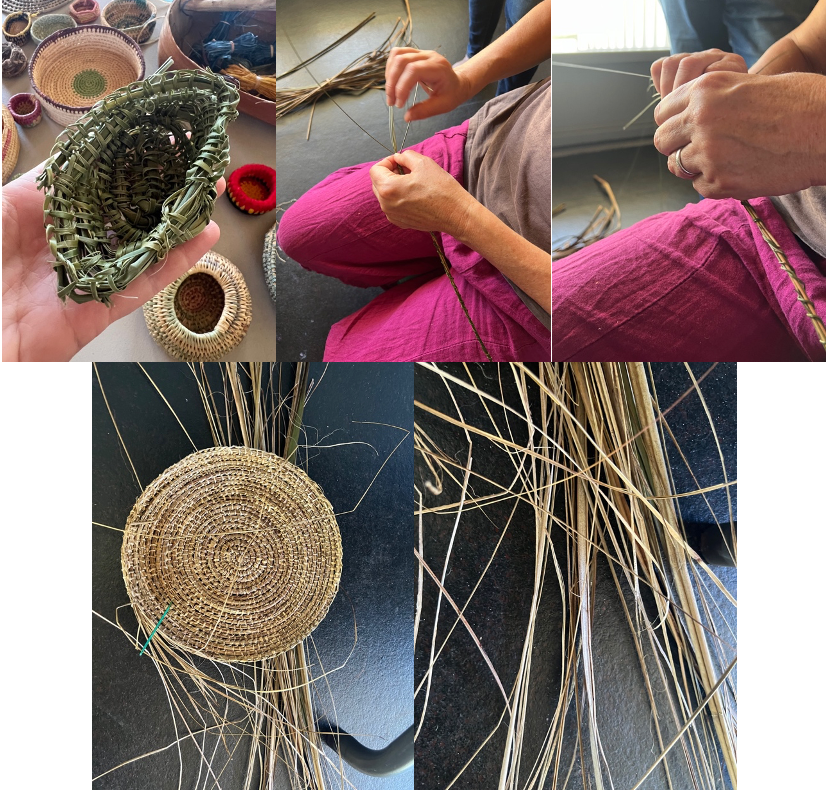
Whilst others continued to weave baskets in circle, my attention towards baskets had waned and I needed to find something with a little more creative flow rather than a mechanical repetition. I switched weaving for drawing. I could feel the stress I had felt in basket weaving release and the process became more meditative, more fluid.

Drawing in collaboration with gum nuts. Coffee rock and fungus water. Outlines in graphite.
Plant dyeing with Leanne Simpson

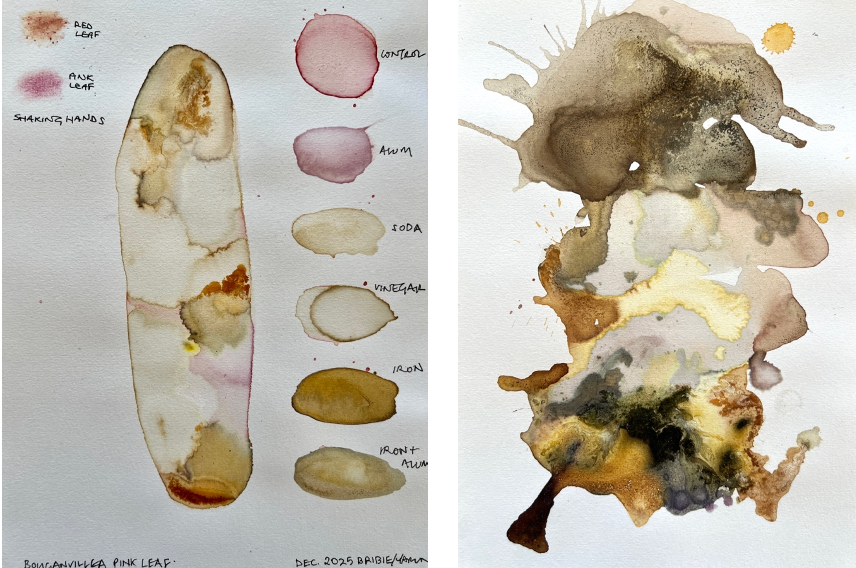
Test rubbings. Rubbing the petals and plants onto paper gives you an idea if it has any dye to offer you.

My own test -bouganvillea- I wanted to try this as I have this plant in my own garden. The second test is of all the samples mixed together and blown, with the addition of mordants; alum, soda, vinegar and iron.
Open day 7th December 2025
Jayda and her cocker spaniel Jarrah from Nature’s Nose. Sniffer dog protecting wildlife. Can smell scat of the following animals short nose echinadas, Bush tail poteroos, Koala and wallaby. Works in National parks.
Kylie
Sit with country, sit with river to see what country wants to make. Attune to her.
Sky country research – Shawn Wilson (research is ceremony)
Professor Chris Matthew’s
Kagan Learning
Indigenous Futures Conference
String theory- not letting anything or anyone go
Aborigine’s- the first scientists/ mathematicians
String theory- how all matter is connected
Call in the light connect to the sun
Woman’s groups
Connect with the elders
Find elders through weaving
Tara Brabazon
What is the mythology of the UAE prior to Islam?
Kinship law- Chris Matthews
Trip to Nungeena 7th December- ‘women’s business’ sacred site of birthing trees- a not for profit orginisation dedicated to healing, empowerment, and cultural preservation for Aboriginal women.
(website www.caloundrachronicle.com)
Intro by Hazelle Mace- site manager
Mythology
Nalbo tribe

Sited at the foot of Mount Beerwah, originally known as ‘Mother Mountain’ to the Indigenous people of the area. We could not visit the actual birthing trees as brown snakes were nesting and it was considered too dangerous.

Swamp Mahogany- this would have been the kind of tree that women would have used during childbirth at Nungeena. (this one found on the Joondiburri walk on Bribie)
‘MOB’ cards
(The word MOB has multiple uses in Aboriginal language meaning family, group, clan or tribe)

Loved these cards that were found at Nungeena. Things I have never asked myself or found out about of another.
What is your totem? How do you connect to our culture through your totem?
As a child I was fascinated by turtles and my favourite toy was a very small cuddly green turtle that I would carry around with me everywhere. In coming to this resicency I understood there were many similarities between Bribie Island and the island of Abu Dhabi where I live- a sand island of similar size, similar weather, mangroves, stingrays, turtles and dugongs.
At some point during the residency I am standing at the main entrance and read the sign on the recreation centre- and realise it is apportioned to St Andrew – a fisherman and patron saint of Scotland. Hailing from Scotland and through family lineage there are immediate connections to St Andrew- on my father’s side fishermen and on my Mother’s (Leiper) Dutch basket weavers (potentially- still unverified) Both my Grandmother and Mother have the first name Muriel meaning Bright Sea.
In manifold ways I see the connection to my totem and to this place I have found myself in.
(Note – St Andrew was crucified on an X shaped cross and gives the Saltire its emblem)
Experiment with Trudy 8th December
Sand turtles with turtle jelly mold on Bribie beach
Double click 1st image to play

Visit to Bribie Kindergarten and Joondoburri Walk 8th December
At first I thought it odd to visit a local kindergarten during an art residency. However on reflection I see that it really instilled that everything and everyone is interwoven and the importance of weaving those threads. The meeting with Ron, his research and book publication with the children and wider community, the integration of the public into the children’s space and the importance of plants (and caring for them), creativity and freedom. This visit was married with the Joondiburri walk, set behind the kindergarten and a trail mapping 27 local species of trees, as well as nesting bats.


Soap tree Alphitonia excelsa. Aboriginal use: bark and roots for sore eyes, toothache. Bark and roots chewed for upset stomach. Leaves and roots for bites from stingray, snakes and insects.


Five Corners Styphilia Viridis. Aboriginal Use: Ripe fruit eaten

Blue Gum, Eucalyptus tereticornis. Aboriginal Use: Wood for shields. Nectar sucked from flowers.

Quandong Elaeocarpus obovatus. Aboriginal Use: Fruit eaten raw or squashed and mixed with water to make an edible paste.

Ring Tree Eucalyptus tereticornis. Aboriginal Use: Ceremonial tree
Note to self!
Bunya Tree (Araucaria bidwillii): Also known as the Bunya Pine, this tree is famous for its massive cones (up to 10kg) and edible nuts. It has many traditional names including banya, bonye, bunyi, and bunya-bunya.
Bunyip: This is a mythical water creature said to haunt swamps, billabongs, and riverbeds. It is not a plant, though some people mistakenly use "bunyip" as a colloquial term for the tree.
3D printing with Martin Drury 10th December 2025
In blender 3d print
Make manifold
In printer (Creality)
Slice
Export stl
(Printing in compostable resin)

Tamsin Kerr Workshop2 How Do We Know What We Know? 10th December 2025
Sitting in circle with talking stick
Haptic Knowledge? Another way of knowing?
How do we priviledge the heirarchy of value?
How do we make space for the things we do not know?
For me traditional western education education system as grounding, then self driven exploration to know more of other ways of being in the world. Of embodied knowing. Friends and family. Of encounters with strangers. Of mishaps or misdirection. From ancestors and ceremony and rituals and spirits. From rocks and flowers and trees.
Recommendation- John Hanson Mitchell- Ceremonial Time
Senses, experiment, vibration, pain and sorrow, joy, spirits, ancestors, multi-dimensional remembrance
I know by my unknowing
All my knowledge has value- even the shadow side
In contributing to others
My knowing from spirit that sits in the body, an experiential knowing
Silence
Research is ceremony, all accountable- How do we make it/ us accountable?
Knowing is accountable. How do we make sure to make space for this to emerge and to make sure it’s okay for this to come out?
Skill of listening
Gratitude and honouring
Ritual and ceremony in the process of an artwork and sharing that in the space for one person to receive
Through sharing
Leanne- a process of becoming everything and unfolding. Patience.
Ali- curiosity
Yvonne- We become the knowledge
Cate- to be porous
Eco-dyeing with Yvonne and Tracey 10th December 2025
2-3 parts water, 1 part vinegar
Pre soak
Add mordants- rusty things, citrus fruit?
Wrap around a wooden dowel then tie with string. Keep space at end of dowel to sit in the water.
Boil for minimum 2 hours.
Results were not great. Steaming continued for another 2 hours, but still not successful results.


10th December 2025 Tradition of Possum Cloaks
A possum skin is gifted to a child each year from birth. They then stitch these skins together in rectangles and burn the designs of their life story and totems, traditionally with a fire stick, onto the inside of the skin and paint with ochres, although now more commonly burnt using the technique of pyrography.
(Tradition revived after the 2006 commonwealth gamess) Possum skins are not available for sale in Australia so come from New Zealand. Possums are protected, hunting and trapping of possum skins is prohibited and so imported from New Zealand where they are considered a pest.
Here 24 skins stitched together, 1 for each year of her life.

Inside of possum cloak wearing her possum cloak (1 year to make)
Mick Harding Possum cloak Taungurung

Gallery visits
Brisbane- 30th November 2025
Queensland Museum/ Art Gallery, Brisbane
Indigenous Australian art

Top
Anchor Barbuwa Wurrkidj, Kunwinkju people. Mythical echidna hunted by mimih c. 1960’s
Natural pigments on eucalyptus bark.
Bottom
Yirrwala, Kunwinkju people Echidna 1959, Natural pigments on bark

Lena Karinkura, Kune/ Rembarrnga peoples. 1961
Jamu (dog) 2003
Twined pandnaus (Pandanus spiralis) and wood with natural pigments and PVA fixative

Mavis Ngallametta Kugu-Uwanh people, Putch clan
Dragging net at Less Creek 2015
Natural ochres and charcoal with acrylic border on linen primed in synthetic polymer paint.

Kathleen Shillam (1916-2002) (Brisbane artist) Banksia pods and Banksia Flowers, (1950’s to 1960’s)
Linocut hand coloured on paper
Gallery of Modern Art, Brisbane
Simryn Gill Forest (portfolio) 1996 Gelatin silver photo on paper

Each photograph in Forest (portfolio) shows different plants, sometimes roots, in Singaporean and Malaysian locations that are generally abandoned. These are not formal garden settings where plants and trees have been selected and carefully tended but diverse locations, such as an abandoned Chinese towkey bungalow; the beach side in Port Dickson, Malaysia; a disused army resenrve; roadside locations; and an army housing estate in Singapore.
Placed among the foliage are fragments of text taken from an eclectic selection of books, including a Chinese cookbook, the Ramayana, Lord Jim, Robinson Crusoe, On the Origin of Species, Frankenstein and a fragment from a book about Japan’s involvement in World War Two. Displayed within a tropical landscape, these culturally inflected texts are destined to decompose: as such, Forest (portfolio) can be read as metaphor for the societal changes that come with the passing of time.
This work also explores the interface and tension that exists between human culture and nature. Once inserted among the foliage and photographed, the pieces of text were left in situ for time to take its course: the strips and fragments eventually disintegrated. The photographs work as documents which fictionalize a moment and location in an object which now assumes memory. The knowledge that the 'cultural' component of these photographs, the paper, is destined to decompose literally means that the photograph works as a document of an invisible ephemeral installation, made over time and geography.
Gallery text and exert from gallery online essay. No author.
Further images from the collection.
Sydney- MCA- Yasmin Smith (MA Art and Ecology @ Goldsmiths) – ceramics with natural glazes – working with nature and place. Site as source.

Yasmin Smith, Manchester Driftwood, 2025 white stoneware with Manchester Ship Canal driftwood ash glaze

Yasmin Smith, unknown title
Mulkun Wirrpanda (1947-2021)
Bark paintings with natural pigments

Indigenous – memorial poles- tree for burying the dead
Bodies would be left to decompose then their bones wrapped in cloth and placed inside the trees.

Warrnambool Art Gallery- Bronywn Razem (Gunditjmara master weaver) weaving and possum skin in contemporary art


Comments